
Radon levels below 2.0 pCi/L are generally considered low-risk, but the EPA recommends taking action once levels hit 4.0 pCi/L or higher. Here is what the numbers actually mean, how testing works, and what Florida homeowners need to know.
Most people have never seen radon, smelled it, or even thought about it until it shows up on a home inspection report. But this invisible gas is responsible for more than 21,000 lung cancer deaths every year in the United States, according to the EPA and the CDC. If you are buying, selling, or simply living in a home in Southwest Florida, understanding radon levels is one of the simplest things you can do to protect your family. This guide covers what the numbers mean, how testing works, and when to call a pro like Accurate Home Inspectors of Florida.
What Is Radon and Why Does It Build Up Indoors?
Radon is a naturally occurring radioactive gas that forms when uranium in soil and rock breaks down. It seeps up through the ground and enters homes through cracks in foundations, gaps around pipes, sump pits, and crawl spaces. Once inside, it can build up to dangerous concentrations.
You cannot detect it on your own. Radon is colorless, odorless, and tasteless. That means a home can have dangerous levels with zero visible warning signs. When you breathe radon in, radioactive particles get trapped in your lungs. Over the years, that exposure can damage DNA and lead to lung cancer. It often takes decades before symptoms appear, and by then, treatment is harder.
Any type of home can have elevated radon: new construction, older homes, slab foundations, crawl spaces, even condos. Florida’s geology (primarily limestone and sandy soil) means radon tends to dissipate faster than in granite-heavy northern states. That said, the Florida Department of Health reports that 1 in 5 Florida residents tests above the EPA action level, and in some parts of the state, that number is closer to 1 in 2.
What Radon Levels Are Considered Safe?
Radon is measured in picocuries per liter of air (pCi/L). There is no level that is completely risk-free. The goal is always to get levels as low as possible.
Here is how the thresholds break down:
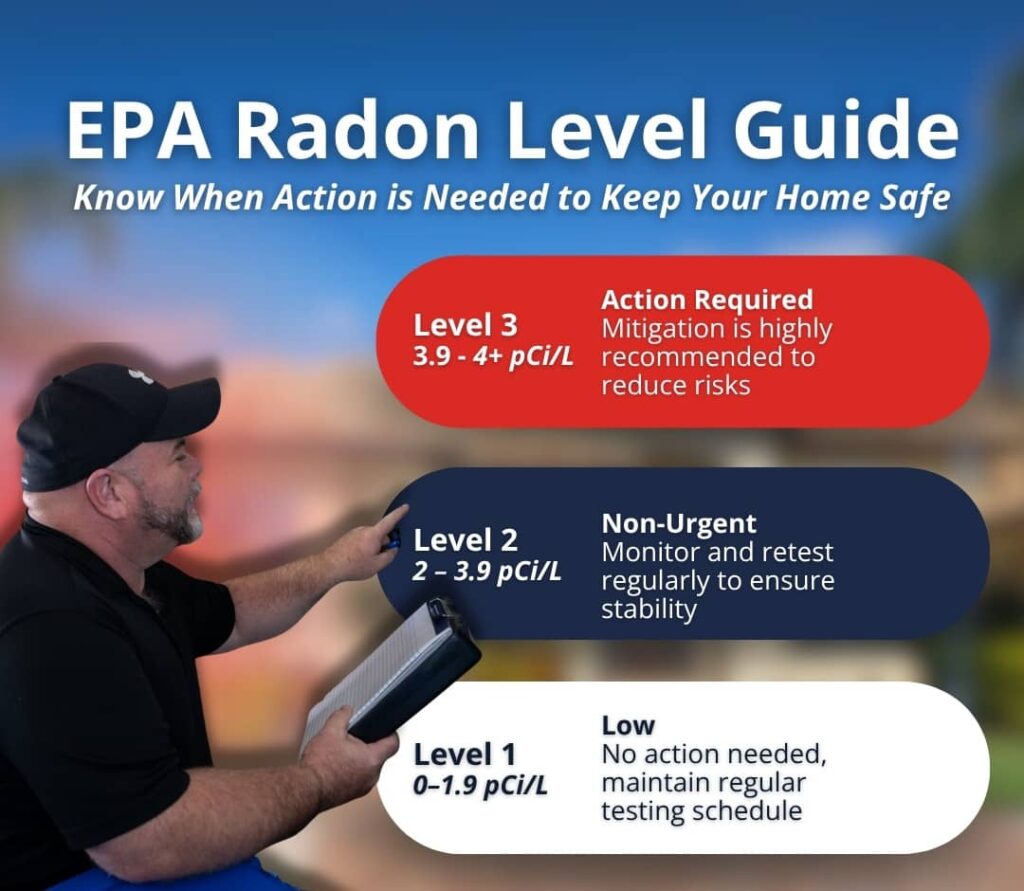
| Level (pCi/L) | What It Means | Recommended Action |
| Below 2.0 | Low-risk | No immediate action; monitor periodically |
| 2.0 to 2.7 | Moderate to low-risk | EPA says consider mitigation; WHO recommends it |
| 2.7 to 4.0 | Moderate to high-risk | Both the EPA and the WHO recommend mitigation |
| 4.0 and above | High risk; EPA action level | Mitigate promptly |
| 20.0 and above | Very high risk | Immediate action required |
EPA Action Level: 4.0 pCi/L
The EPA has held this threshold for decades.
At 4.0 pCi/L, roughly 7 in 1,000 non-smokers exposed over a lifetime are estimated to develop lung cancer from radon alone. That is higher than most environmental risks we treat as routine. The EPA recommends fixing your home when levels reach this threshold.
WHO Recommendation: 2.7 pCi/L
The World Health Organization (WHO) sets a stricter target of 2.7 pCi/L. This is the level where both major health organizations agree that mitigation is a smart move to reduce long-term risk. If you have young children, elderly family members, or anyone with respiratory conditions at home, treating 2.7 pCi/L as your personal action point makes sense.
The “Safe” Floor: Below 2.0 pCi/L
Below 2.0 pCi/L is about as clean as indoor air gets for radon. The EPA’s average for American homes is approximately 1.3 pCi/L. If your home tests below 2.0, you are in good shape. Retesting every two to five years is still a good habit, since levels can shift after renovations, HVAC changes, or foundation work.
How Does Radon Get Into Your Home?
Radon moves upward through soil and enters through any opening between the ground and your living space. Common entry points include:
- Cracks in concrete slabs or foundation walls
- Floor-wall joints in basements
- Open sump pits
- Gaps around utility pipes
- Crawl space openings
Florida homes are primarily built on slabs or crawl spaces, which means radon tends to accumulate at ground level rather than in a basement. That affects where you should test: always at the lowest livable floor where you spend at least seven hours per week.
Seasonal changes also matter. Radon levels tend to be higher when homes are sealed up with closed windows and reduced ventilation, which is worth keeping in mind when scheduling a test.
How Does Radon Testing Work?
Testing is the only way to know if your home has a radon problem. You cannot smell, see, or taste it. The process is simple and relatively quick.
Short-Term Tests
Short-term tests run for two to seven days. A professional places a detector (charcoal canister or similar passive device) at the lowest livable floor, leaves it undisturbed, then mails it to a lab. Results come back within a few days.
For these tests to be accurate, keep windows and exterior doors closed for at least 12 hours before the test and throughout. Opening windows invalidates the result by flushing radon out temporarily.
Short-term tests are the standard choice for real estate transactions because they deliver results quickly.
Long-Term Tests
Long-term tests run for 90 days or more, typically six to twelve months. They capture radon across different seasons and give you a better picture of your annual average. If you are not in the middle of a home sale, a long-term test gives more reliable data.
Professional vs. DIY Testing
DIY kits from hardware stores cost around $20 to $50 and work reasonably well when instructions are followed. The limitation is placement. Putting the device in the wrong spot or in the wrong conditions skews results.
A professional radon test uses a continuous radon monitor (CRM), which logs hourly readings and tracks environmental conditions like humidity and air pressure. This makes it harder to tamper with and easier to spot interference. For real estate transactions, a professional test conducted by a certified inspector is the recommended option.
Radon testing is typically not included in a standard home inspection, but many certified inspectors offer it as an add-on. Similarly, for mold concerns that sometimes accompany radon-related water and foundation issues, having a plan for remediation and post-remediation verification is important for indoor air safety.
What to Do If Your Radon Levels Are High
If your test comes back at 4.0 pCi/L or above, the next step is radon mitigation. Do not panic; this is manageable.
A certified radon mitigation contractor installs a sub-slab depressurization system, which is a pipe and fan setup that draws radon from beneath the foundation and vents it outside. This process can reduce radon levels by up to 99%. The average cost for a mitigation system is around $1,500, though it varies by home size and foundation type.
After Installation, Retest
A follow-up test confirms the system is working and levels have dropped below the EPA action level.
Patching cracks alone is not enough. Sealing foundation cracks can slow radon entry slightly, but it does not address the pressure differential that drives radon in. A proper mitigation system is the only reliable fix.
If your test comes back between 2.0 and 4.0 pCi/L, you have options. You can monitor and retest, improve ventilation, or install mitigation proactively. For homeowners planning to stay long-term, mitigation at this range is a reasonable investment.
When reviewing a home inspection report, it helps to know how other building systems can interact with radon entry points. Roof ventilation, for example, affects the pressure dynamics in a home, and how they function is worth understanding.
Does Florida Have a Radon Problem?
Florida is often considered a low-radon state compared to the Midwest or Northeast. That reputation is partially accurate. Limestone and sandy soil do allow radon to dissipate more easily outdoors than granite-rich soils do. Most Florida homes test below the EPA action level.
But the Florida Department of Health says 1 in 5 Florida homes still exceeds 4.0 pCi/L. In certain areas, that rate climbs to 1 in 2. Elevated radon has been found in single-family homes, manufactured homes, condos, and schools across the state. No region or building type is immune.
Southwest Florida, where Accurate Home Inspectors of Florida serves Lee, Collier, Charlotte, and Hendry Counties, falls in a generally low-to-moderate risk zone on the EPA’s radon map. That does not mean testing is unnecessary. Your neighbor’s home can test normal while yours tests high. Radon levels vary based on soil composition, construction type, and ventilation patterns specific to each property.
The only way to know your home’s radon level is to test it.
Related Questions to Explore
Is there any level of radon that is completely safe? No. The CDC and EPA both state that there is no known safe level of radon. Any exposure carries some risk, though the risk increases significantly as levels rise. The goal is to keep radon as low as reasonably achievable. Below 2.0 pCi/L is considered low-risk by most standards, but reducing levels further is always beneficial.
How long does a radon test take? A short-term test takes two to seven days. A long-term test runs for 90 days or more. For real estate transactions, short-term tests are standard because they deliver results before closing. For your primary residence, a long-term test gives a more accurate picture of your annual average exposure.
Does opening windows reduce radon levels? Opening windows can temporarily dilute radon, but it is not a long-term solution. Once windows close, radon throughout the home returns to previous levels. For radon testing specifically, windows and exterior doors should stay closed for at least 12 hours before the test begins. Open windows during testing produce artificially low readings that do not reflect real living conditions.
What are the symptoms of radon exposure? Radon exposure has no immediate symptoms. You will not feel sick, experience headaches, or notice anything unusual. The damage is cumulative and takes years or decades to manifest, most commonly as lung cancer. By the time symptoms from radon-related lung cancer appear, the disease is typically advanced. This is why testing is so critical: there is no other way to know.
How much does radon mitigation cost? Most radon mitigation systems cost between $800 and $2,500, depending on the size of the home, foundation type, and local contractor rates. The national average is around $1,500. After installation, a retest confirms the system is working. Some contractors offer guarantees to reduce levels below 2.0 pCi/L. Given the lung cancer risk associated with long-term exposure, mitigation is considered a high-value investment relative to cost.
When to Call a Professional
If you are buying or selling a home in Southwest Florida, a professional radon test is the smart move. DIY kits are a reasonable first step for a primary residence, but for real estate transactions, the stakes are too high for improper placement or handling.
A certified inspector uses a continuous radon monitor (CRM), which provides hourly readings, logs environmental conditions, and produces a tamper-evident report you can share with buyers, sellers, or your agent. The test typically runs for 48 hours and delivers results shortly after retrieval.
Signs a professional test is the right call:
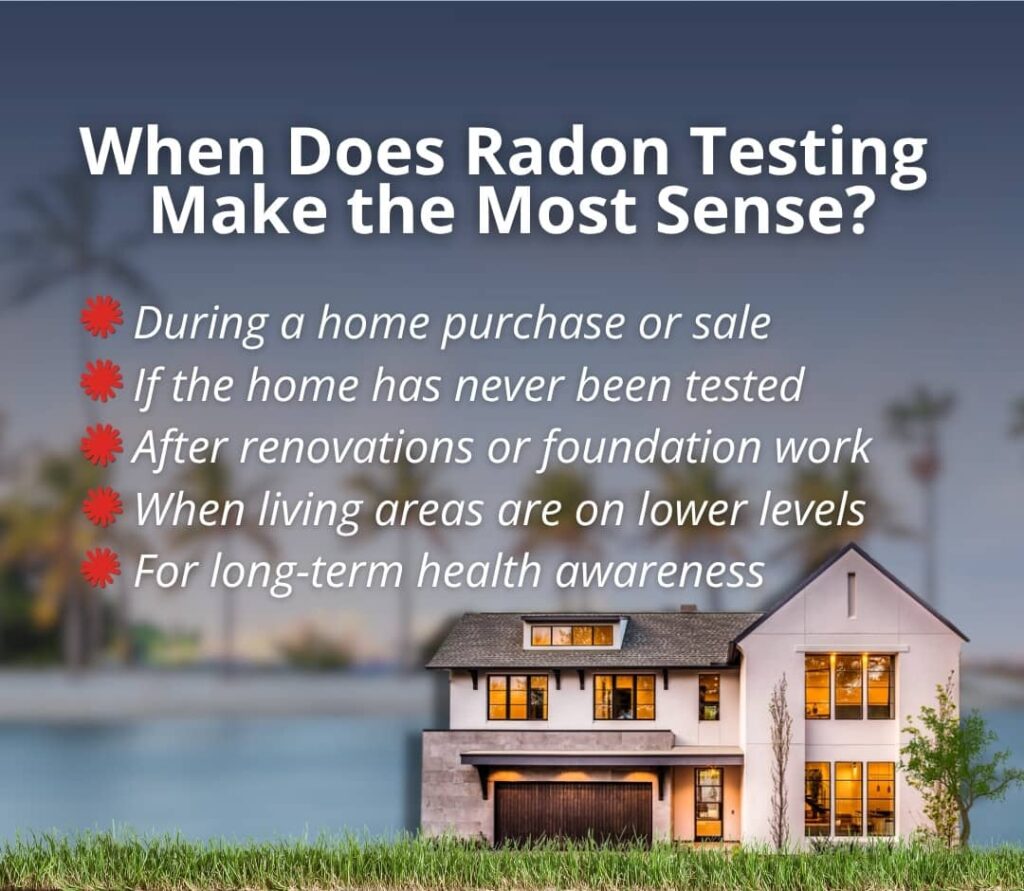
- You are in the middle of a home purchase or sale
- Your DIY test came back between 2.0 and 4.0 pCi/L, and you want confirmation
- Your home has had recent foundation work, HVAC changes, or radon mitigation installed
- You have never tested, and your home is over five years old
Accurate Home Inspectors of Florida serves Lee, Collier, Charlotte, and Hendry Counties. Radon testing is available as an add-on to a full home inspection. Schedule your inspection and ask about radon testing when you book.
Conclusion
Radon is a real health risk, and it does not announce itself. Here is what to take away:
- The EPA recommends fixing your home at 4.0 pCi/L or higher; the WHO recommends action at 2.7 pCi/L
- There is no completely safe level, but below 2.0 pCi/L is considered low-risk
- Testing is the only way to know your home’s radon level
- Florida still has a radon problem in roughly 1 in 5 homes, despite the state’s geology
If you are ready to test your home, a certified home inspector can handle it as part of a full property evaluation. Contact our team at Accurate Home Inspectors of Florida to schedule your inspection in Fort Myers, Naples, Bonita Springs, or the surrounding Southwest Florida area.