

A Florida wind mitigation report is an inspection document that records the wind-resistant features of your home on a state form called the OIR-B1-1802.
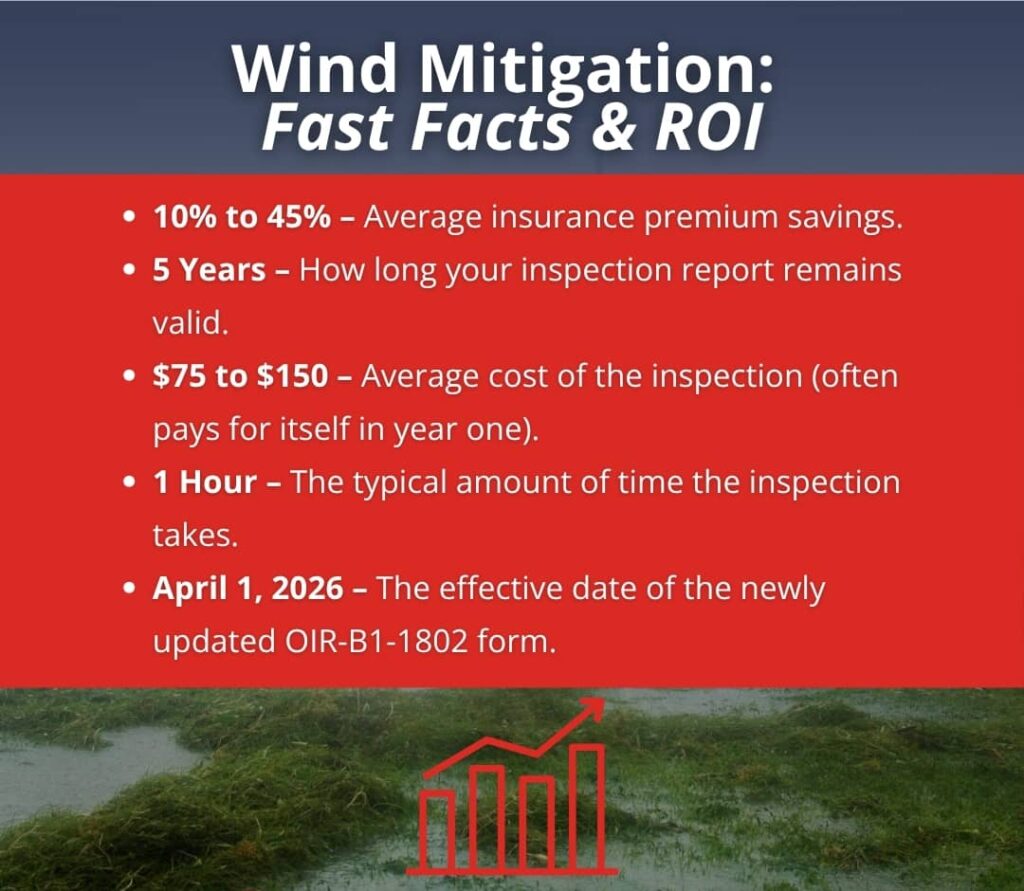
Insurers use it to apply discounts to the windstorm portion of your premium, and many Florida homeowners save anywhere from 10% to 45% once those features are verified.
The inspection takes about an hour, the report is good for up to five years, and for many homes, it pays for itself the first year.
Here is what the report covers, how much you can save, and what changed with the 2026 version of the form.
What Is a Florida Wind Mitigation Report?
A wind mitigation report documents how well your home is built to resist hurricane-force winds. A qualified inspector photographs and verifies specific construction features, then records them on the Uniform Mitigation Verification Inspection Form (OIR-B1-1802), the standardized form issued by the Florida Office of Insurance Regulation.
You hand that completed form to your insurer or agent, and they apply the credits you qualify for.
Florida law requires every residential property insurer to offer premium discounts for verified wind-resistant features. The state’s wind mitigation resources from the Florida Office of Insurance Regulation explain the program and host the official form.
The inspection is not legally required, but without the report, your insurer has no way to know your home qualifies, so you pay the full windstorm rate by default.
For homeowners in Fort Myers, Naples, and the rest of Southwest Florida, where windstorm coverage is a large share of the bill, a wind mitigation report is one of the few inspections that can put money back in your pocket every year.
What a Wind Mitigation Inspection Checks
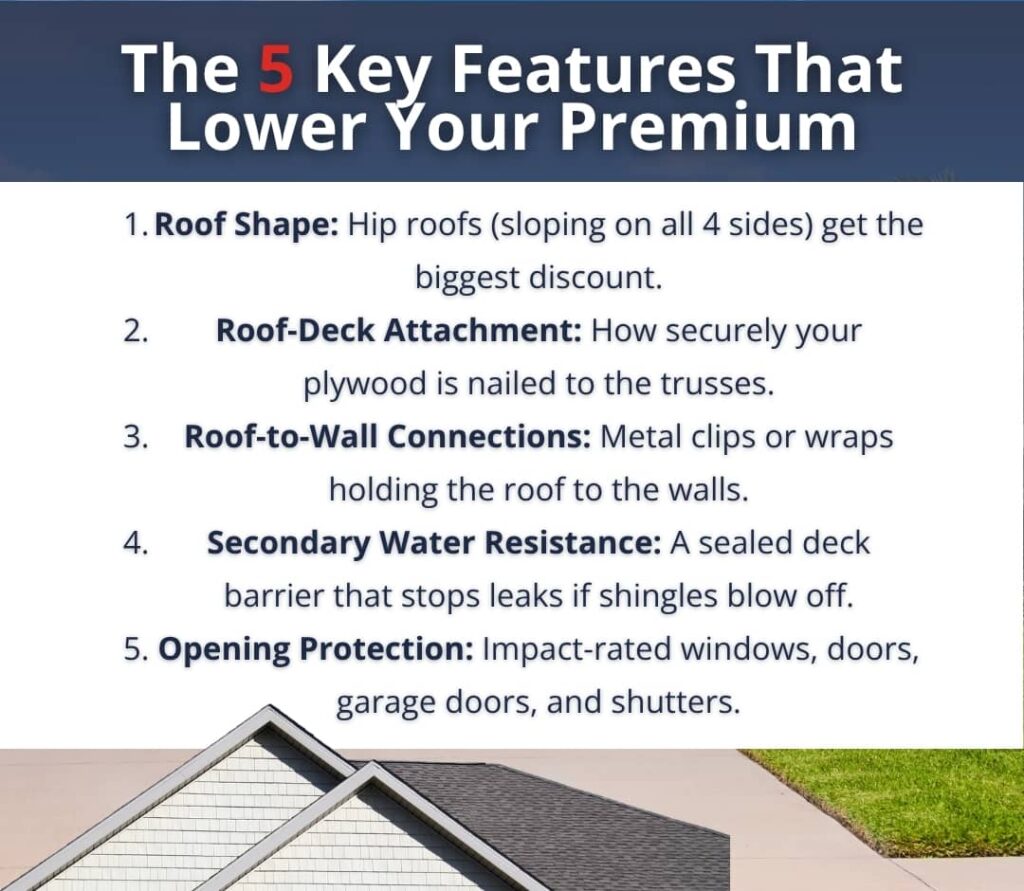
The inspector evaluates a short list of features. Five of them drive most of the savings.
Roof shape
Roof geometry matters more than almost anything else. A hip roof, which slopes down on all four sides, sheds wind far better than a gable roof and earns the largest single discount. To qualify as a hip roof, roughly 90% or more of the roof perimeter must be hipped.
Roof-deck attachment
This is how the plywood or sheathing is fastened to the trusses. The inspector checks nail type and spacing. Larger nails (8d) at closer spacing hold the deck on in high winds far better than smaller nails spaced wide apart.
Roof-to-wall connections
This is how the roof structure is tied to the walls, and it is often the weakest link. Connections range from simple toenails (weakest) to metal clips, single wraps, and double wraps (strongest). The weakest connection found usually governs the credit.
Secondary water resistance
If the roof covering blows off, a sealed roof deck or self-adhering membrane underneath keeps water from pouring into the home. Having this barrier earns an additional credit.
Opening protection
Impact-rated windows, doors, garage doors, and skylights, or approved storm shutters, protect the openings that wind and debris attack first. Protecting every opening to code earns the strongest opening-protection credit.
How Much You Can Save (and What It Costs)
A wind mitigation inspection in Florida typically runs about $75 to $150, and many inspectors discount it when you bundle it with a 4-point inspection. The savings on the other side are usually much larger.
Depending on your home’s features, credits commonly reduce the windstorm portion of the premium by 10% to 45%, which for many homeowners means hundreds of dollars a year, every year, for up to five years.
Because the savings stack across the life of the report, the inspection often pays for itself almost immediately. The features an inspector documents here overlap with the electrical, roof, plumbing, and HVAC items reviewed during a 4-point inspection, which is why the two are so often ordered together.
If you are insuring an older home, read what a 4-point inspection covers and when to get one in Florida to see how the two reports work together.
What’s New: The 2026 OIR-B1-1802 Form
Florida updated the wind mitigation form in 2026. The revised OIR-B1-1802 (Rev. 04/26) took effect April 1, 2026. It reflects the state’s 2024 residential wind-loss mitigation study, including updated roof-to-wall connection options.
If you had an inspection on the older form, it remains valid for its original term, but any new report will use the current version. A consumer-friendly overview of the discount program is available in the Florida CFO’s guide to hurricane mitigation discounts.
Related Questions to Explore
How much does a wind mitigation inspection cost in Florida?
Most cost about $75 to $150, with discounts common when bundled with a 4-point inspection. The premium savings usually exceed the cost in the first year.
How long is a wind mitigation report good for?
Up to five years, as long as no material structural changes are made to the roof or openings. After that, you’ll need a new inspection to keep the discounts.
Who can perform a wind mitigation inspection in Florida?
Licensed home inspectors with the required hurricane-mitigation training, along with general contractors, building-code inspectors, professional engineers, and architects.
Which roof shape gets the biggest discount?
A hip roof, sloping down on all four sides, earns the largest roof-shape credit. About 90% or more of the perimeter must be hipped to qualify.
Is a wind mitigation inspection required in Florida?
No, it isn’t legally required. But it’s the only way to claim the insurance discounts you may already qualify for, so most homeowners come out ahead by getting one.
When to Call a Professional
A wind mitigation report has to be completed and signed by a qualified inspector, so this is not a DIY project. Call a licensed inspector if you are buying a home, renewing or shopping for insurance, just replaced your roof or installed impact windows, or your current report is approaching its five-year expiration.
Homeowners across Lee, Collier, Charlotte, and Hendry Counties can schedule with Accurate Home Inspectors of Florida. If you recently upgraded your roof or openings, a fresh inspection can unlock credits you weren’t getting before.
Conclusion
A wind mitigation report is one of the few inspections that can lower your bills instead of just protecting you from surprises. It documents the features that make your home wind-resistant, qualifies you for insurance credits worth up to 45% of your windstorm premium, and stays valid for up to five years.
Pair it with what a 4-point inspection covers and when to get one in Florida if you’re insuring an older home, and call Accurate Home Inspectors of Florida to schedule your wind mitigation inspection.